 Largo Siding
 Siding That Has to Work Harder in Belleair Bluffs
Belleair Bluffs sits in one of the more exposed pockets of Pinellas County. It's a small, mostly residential city wedged between Largo and the water, and homes here take a steady beating that inland Florida properties simply don't see. Salt-laden air moves in off the harbor and Intracoastal side of the peninsula almost daily, summer humidity stays punishing for months at a time, and when a tropical system tracks anywhere near the Gulf, Belleair Bluffs is close enough to the coast to catch sustained wind loads and wind-driven rain that push water sideways into every seam, joint, and fastener hole in a home's exterior.
Siding in this environment isn't just a cosmetic layer. It's the first line of defense against moisture intrusion, and it's constantly cycling through UV exposure, heat expansion, and salt exposure that will find any weakness in a product or an installation. That's the lens we use on every Belleair Bluffs project: does this material, and this installation method, actually hold up here — not in a showroom, not in a mild climate, but on this coast, year after year.
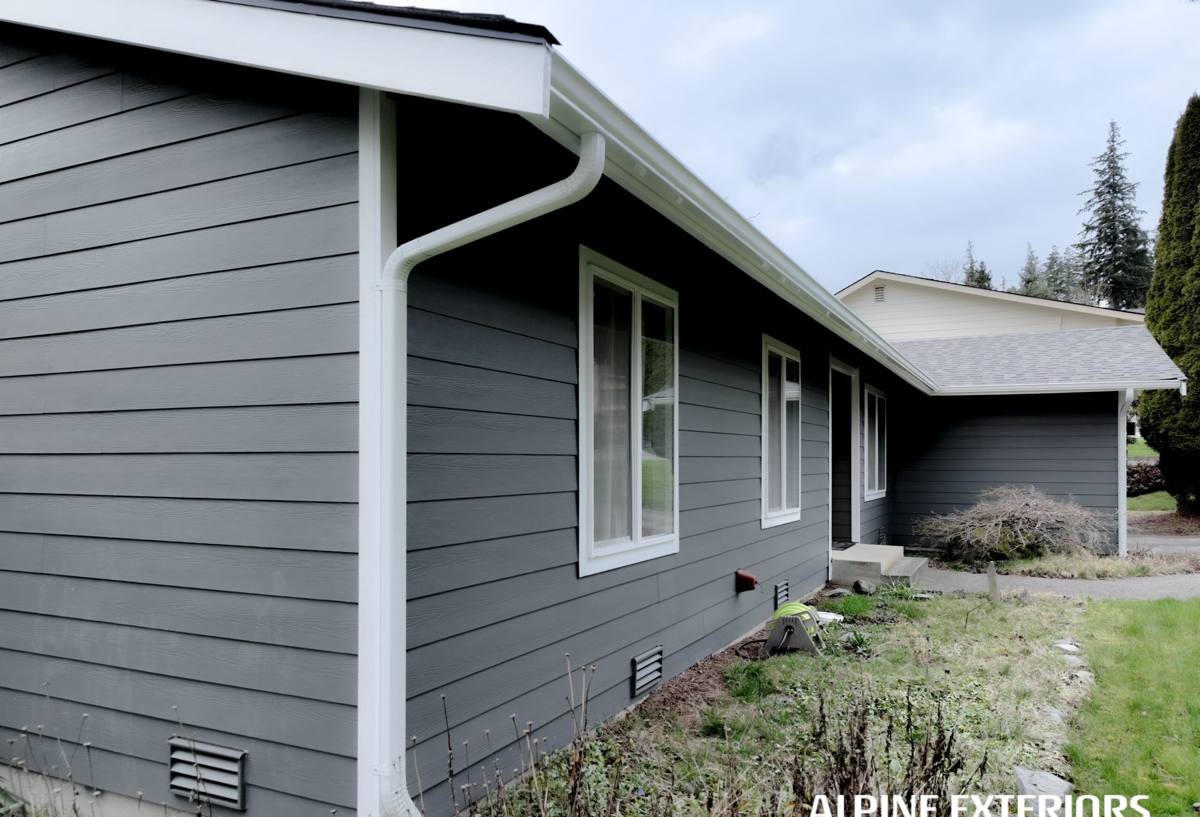
Why We Only Install James Hardie
We install James Hardie fiber cement siding exclusively. We don't install vinyl, LP SmartSide, Cemplank, Allura, or primed wood siding like spruce or cedar, and that's a deliberate standard, not a lack of options. Each of those alternatives has a real weak point in a coastal Florida climate — vinyl softens, warps, and fades under sustained UV and heat; engineered wood products carry moisture risk at cut edges and fastener points if flashing and sealing aren't perfect and stay perfect for decades; cedar and primed wood need an ongoing maintenance commitment most homeowners don't want to sign up for.
James Hardie fiber cement is manufactured from cement, sand, and cellulose fiber. It doesn't burn, it doesn't rot, it isn't a food source for pests, and it holds paint and factory-applied color far longer than wood-based alternatives because it doesn't expand and contract with humidity the way wood products do. That dimensional stability matters enormously in a climate that swings from soaking humidity to intense dry heat within the same week.
Built for This Exact Climate: HZ5 and HZ10
James Hardie engineers its siding by climate zone, not as a one-size-fits-all product. Florida falls into the HZ10 category — Hardie's harshest-climate engineering tier, built specifically to resist moisture and higher humidity exposure better than the HZ5 product formulated for milder, drier regions. When we spec a Belleair Bluffs job, we're specifying HZ10 product by default. That single decision — getting the right climate zone product on the house — is one of the most common things a homeowner never thinks to check, and one of the easiest ways an inexperienced installer gets it wrong.
What a Correct James Hardie Installation Actually Involves
James Hardie siding fails prematurely almost exclusively because of installation error, not product defect. The material itself is proven; the workmanship is where jobs go right or wrong. A correct install on a Belleair Bluffs home includes:
- Proper starter strip and clearance — siding held off the foundation and any hard surfaces per Hardie's published clearance requirements, so wicking moisture never has direct, sustained contact with the bottom edge of the board
- Correct fastener pattern and depth — nails or screws set flush, not overdriven, in the pattern Hardie specifies for the product and wind zone, because overdriven fasteners crack the board and underdriven ones work loose in high wind cycling
- Flashing at every penetration — windows, doors, hose bibs, vents, and any wall penetration properly flashed and integrated with a weather-resistant barrier before a single course of siding goes up
- Correct joint treatment — butt joints either flashed or sealed per Hardie's detail, not just caulked and hoped for
- Factory-cut edges sealed — any field-cut edge primed or sealed per Hardie's guidelines so the cut edge doesn't become the one unprotected entry point for moisture
- Manufacturer-approved fasteners and accessories — using Hardie's specified corrosion-resistant fasteners, especially important this close to salt air, where the wrong fastener metal corrodes and stains or fails years before the siding itself would
Skip any one of these steps and the siding can still look fine on installation day. The failures show up two, five, or ten years later — as streaking at joints, soft spots at the bottom course, or fastener bleed-through — long after the crew that cut the corners is gone.
What Wind-Driven Rain and Salt Air Actually Do to a Home
It's worth being specific about the two climate stresses that matter most in a location like Belleair Bluffs, because they attack a home differently.
Wind-driven rain doesn't fall straight down — during a coastal storm it's pushed horizontally into the wall assembly, which means water finds any gap at a joint, corner, or penetration that a calm-weather install would never expose. This is why flashing detail and joint treatment matter more here than almost anywhere else, and why a house that looks fine in dry weather can still be taking on water during every squall line that comes through.
Salt air is a slower, quieter problem. It accelerates corrosion on any exposed metal fastener, degrades lesser paint and coating systems faster than an inland environment would, and combines with UV exposure to break down finishes that aren't rated for it. James Hardie's ColorPlus factory finish is baked on and cured under controlled conditions specifically to resist UV fading and hold up to this kind of exposure far longer than a field-applied paint job would — which is one reason we push ColorPlus color selections over site-painted Hardie on every coastal job.
Choosing the Right Hardie Product Line for Your Home
Hardie's product lines aren't interchangeable — the right choice depends on the home's architectural style, existing trim details, and how much of a clean, low-maintenance profile the owner wants going forward.
| Product Line | Best Fit | Look |
|---|---|---|
| HardiePlank Lap Siding | Traditional and most common single-family homes | Classic horizontal lap, widest color and texture selection |
| HardiePanel Vertical Siding | Modern or coastal-style homes, accent walls, gable ends | Clean vertical lines, often paired with board-and-batten trim |
| HardieShingle Siding | Cottage or Florida vernacular-style homes | Staggered or straight shingle profile |
| Artisan Lap Siding | Higher-end homes wanting a deeper, more refined reveal | Premium smooth or beaded finish |
We walk every Belleair Bluffs homeowner through which line fits their home's style and their maintenance expectations before we ever talk numbers — the right product for a ranch-style home isn't necessarily the right product for a coastal contemporary a block away.
Our Process, Start to Finish
The steps below are the same on every Belleair Bluffs project, whether it's a full re-side or a repair-and-match on an existing Hardie home.
- On-site assessment — we walk the exterior, check current siding and moisture conditions, look at existing flashing and trim, and measure for material takeoff
- Product and color selection — we go through HZ10 product lines, textures, and ColorPlus color options against the home's style and the owner's goals
- Written estimate — a clear scope of work, product specification, and price before anything is scheduled
- Prep and tear-off — removal of existing siding, inspection and repair of any sheathing or framing issues found underneath before new material goes up
- Weather-resistant barrier and flashing — installed and integrated at every window, door, and penetration before siding starts
- Siding installation — installed to Hardie's fastening, clearance, and joint specifications, with HZ10 product throughout
- Trim, caulking, and touch-up — final detail work, site cleanup, and a walkthrough with the homeowner
We don't skip the tear-off inspection step to save time. Wall sheathing that's been hiding moisture damage under old siding is exactly the kind of problem that has to be caught and corrected before new Hardie goes up — covering it over just resets the clock on the same failure.
What Drives Cost on a Belleair Bluffs Project
| Factor | Why It Matters |
|---|---|
| Home size and complexity | More corners, dormers, and roof lines mean more cutting, flashing, and labor time |
| Current siding condition | Tear-off and any sheathing repair adds time versus a straightforward re-side over sound substrate |
| Product line and finish | Lap versus panel versus shingle profiles, and ColorPlus versus field-painted, carry different material costs |
| Trim and accessory scope | Corner boards, window trim, and fascia work are often bundled into a full exterior job |
| Access and site conditions | Tight lots, fencing, landscaping, and proximity to neighboring homes affect setup and staging time |
We don't quote broad numbers on a page without seeing the home — every property in Belleair Bluffs has a different roofline, a different amount of existing damage, and a different scope. What we can tell you honestly: Hardie costs more upfront than vinyl or engineered wood, and it's priced that way because it's a longer-lived, lower-maintenance product. Homeowners who plan to stay in their home for years, or who want to sell without a siding question mark, generally come out ahead on total cost of ownership.
Maintenance and the James Hardie Warranty
One of the real advantages of Hardie with a factory ColorPlus finish is how little ongoing maintenance it asks for compared to painted wood or aging vinyl. Homeowners should still plan to periodically rinse salt residue and airborne grime off the siding, especially on faces exposed to prevailing coastal wind, and to have caulking and trim checked every few years the way any home's exterior should be inspected.
James Hardie backs its products with a manufacturer's limited warranty that is transferable to a new owner if the home sells — a detail worth knowing if there's any chance of selling in the years after the work is done. The exact terms depend on the product line and are set by Hardie, not by us, and we'll walk you through the specifics that apply to your project when we scope the job.
Signs Your Current Siding May Already Be Failing
- Soft or spongy spots when pressed, especially near the bottom courses or below windows
- Visible staining or streaking running down from joints or fastener heads
- Paint that's bubbling, peeling, or failing faster than it should on a several-year cycle
- Gaps opening up at corner boards, trim, or butt joints
- Warping, buckling, or panels that no longer sit flat against the wall
- A musty smell or visible moisture inside on an exterior wall
Any one of these on its own isn't necessarily an emergency, but on a coastal Pinellas County home it's worth having looked at before the next storm season pushes it further.
Why a Crew That Already Works in Belleair Bluffs Matters
Installation quality is the single biggest variable in how long Hardie siding actually lasts, and that's a function of experience with this exact climate and this exact building stock — not siding in general. A crew that already works Pinellas County homes knows the wind-load and flashing detail this coastline demands, has already worked through the permitting and inspection process local jurisdictions require, and isn't learning HZ10 fastening patterns for the first time on your house. That familiarity shows up in the details that matter most: how tight the flashing integration is at your windows, whether the fastener pattern actually matches the wind zone, and whether the crew treats cut edges and joints the way Hardie's own specifications call for rather than the way that's fastest.
If you're considering a siding project in Belleair Bluffs, we're happy to walk the property, look at what you're working with now, and put together a straightforward, no-pressure estimate — no obligation, just an honest look at what your home needs. You can request one using the form below.