 Largo Siding
 Siding Rarely Fails From the Outside In
When a homeowner in Largo calls about siding trouble, the visible problem — a bubbled panel, a soft spot near a window, a musty smell in a closet on an exterior wall — is almost never the actual problem. It's the symptom. By the time siding looks bad, moisture has usually been working behind it for months or years. Understanding how that moisture gets in, and why Pinellas County's climate makes the problem worse and faster than it is almost anywhere else in the country, is the difference between catching an issue early and discovering a full sheathing replacement.
Largo sits in a stretch of Florida that gets hit from every direction: hurricane-force winds during storm season, intense UV exposure essentially year-round, wind-driven rain that behaves nothing like a normal rainstorm, and salt-laden air drifting in off the Gulf. None of these alone would be catastrophic for a home's exterior. Together, over years, they create conditions that punish siding materials that were never engineered for this kind of exposure.
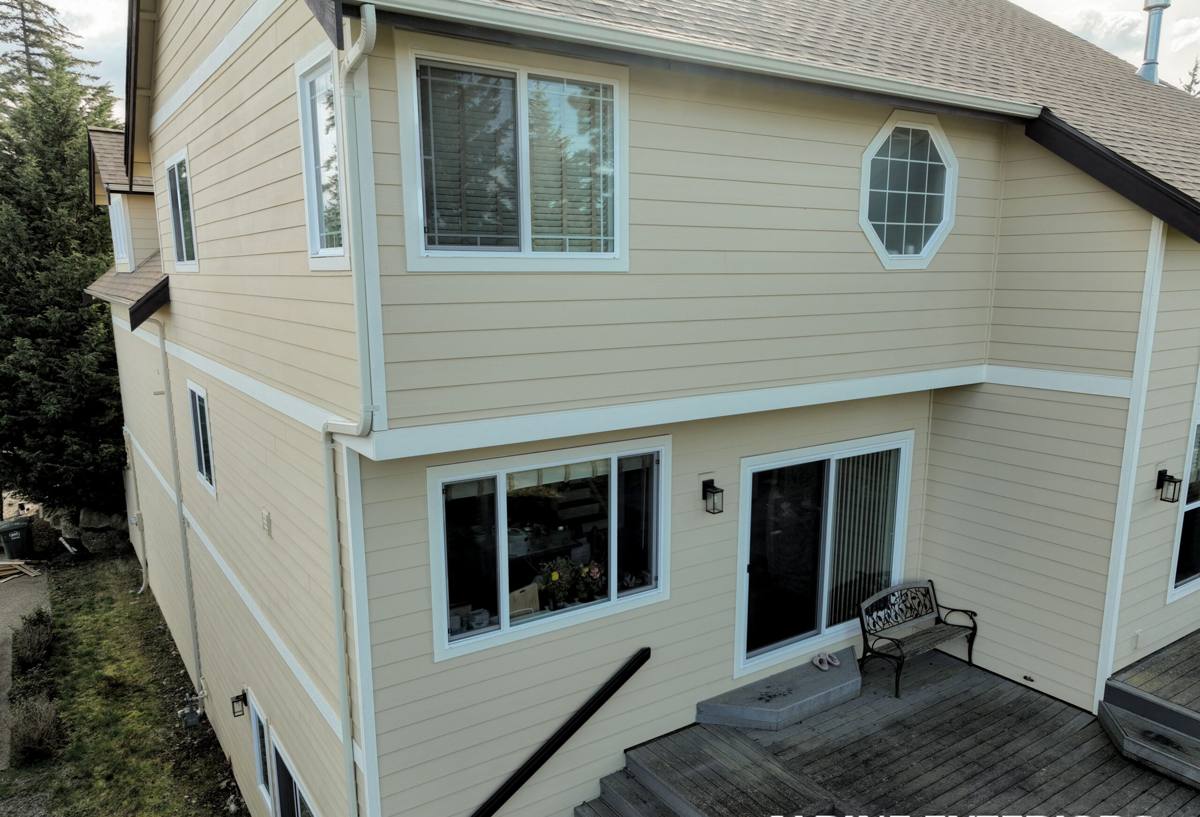
How Moisture Actually Gets Behind Siding
Siding is not a waterproof shell. No siding product, including the ones we install, is designed to be a home's only defense against water. It's the first line of a layered system that includes a weather-resistive barrier (house wrap), flashing at every penetration and transition, and correct fastening and clearances. When any one of those layers is missing, poorly installed, or degraded, water finds a way in — usually in ways you can't see from the driveway.
Wind-Driven Rain vs. Normal Rain
A calm rain falls mostly straight down and sheds off horizontal siding the way it's supposed to. Wind-driven rain, which Largo gets regularly during summer storms and tropical systems, hits siding at an angle — sometimes nearly sideways. That pressure pushes water up under laps, into seams, around trim, and through any gap that would otherwise be irrelevant in a gentler climate. This is why a siding system that performs fine in a low-wind region can leak in coastal Pinellas County even though it was installed "correctly" by the book for that other region.
The Role of the Weather-Resistive Barrier
Behind every siding panel should be a continuous water-resistive barrier, properly lapped shingle-style so water drains down and out rather than pooling. If that barrier is torn, stapled through incorrectly, missing at a seam, or simply skipped to save time, siding can look perfect while the wall behind it is taking on water every time it rains. This is one of the most common failure points we find on tear-offs — the siding gets blamed, but the barrier behind it was the real point of entry.
Warning Signs Homeowners Miss
Most siding failures give off signals long before they become obvious. Few homeowners know what to look for, because the signs rarely show up where you'd expect.
- Paint or caulk that's cracking, peeling, or pulling away at seams and trim joints
- Soft or spongy areas when you press on siding near the bottom courses or below windows
- Visible warping, buckling, or panels that no longer sit flush against the wall
- Discoloration or dark streaking, especially near butt joints and corners
- A musty or damp smell inside on an exterior wall, even without visible staining
- Interior drywall that feels soft, or trim that's separating near windows and doors
- Blistering or bubbling on interior paint on an exterior-facing wall
- Increased insect activity — carpenter ants and termites are drawn to moisture-softened wood
Any one of these on its own isn't necessarily an emergency. Several together, or any of them combined with a home that's more than 10-15 years past its last siding inspection, is worth a professional look.
What's Actually Happening Inside the Wall
Once water gets behind siding and stays there — because it can't drain, dry out, or evaporate fast enough between rain events — it starts doing damage that's invisible from outside. Wood sheathing absorbs the moisture and begins to soften. Framing members can start to rot. Mold and mildew take hold in the wall cavity, often well before anyone smells or sees it from inside the house. Insulation loses effectiveness when it's wet. Fasteners holding the siding itself can corrode or lose their grip in softened wood, which is often what finally causes a panel to visibly sag or pull loose.
The frustrating part for homeowners is that this process is slow and largely silent. A house can look fine for years while sheathing quietly deteriorates underneath. Florida's humidity doesn't help — the wall cavity rarely gets a real chance to dry out between wet events the way it might in a drier climate, so trapped moisture lingers longer and does more cumulative damage per incident.
Why Some Siding Materials Handle This Better Than Others
Not every siding material responds to trapped moisture the same way, and that difference matters more in a climate like ours than it does in most of the country. This isn't about any one product being "bad" — it's about matching material behavior to the actual conditions a Largo home faces.
| Material | How It Behaves When Moisture Gets Behind It | Sensitivity in Coastal Florida |
|---|---|---|
| Vinyl siding | Doesn't absorb water itself, but relies heavily on a perfect barrier and drainage system behind it; can trap moisture against sheathing if not vented and installed with correct clearances | UV exposure over years can make panels brittle; high wind can loosen or dislodge panels rated for lower wind zones |
| Wood-based composite (e.g., OSB-core products) | The core material is wood fiber-based, so if the factory coating or field-applied paint is breached, moisture intrusion can cause swelling and deterioration at the point of entry | Cut edges and fastener penetrations need diligent sealing and repainting on a schedule; humidity and heat accelerate breakdown if maintenance lapses |
| Primed wood or cedar | Natural wood absorbs and releases moisture with humidity swings, which over time causes cupping, splitting, and paint failure at the grain | Requires the most frequent repainting and caulking of any common option in a hot, humid, high-UV climate |
| Fiber cement (James Hardie) | Cement-based composition doesn't swell, rot, or support insect activity even with moisture contact; factory-applied finish is engineered for the coating, not the substrate, to shed water | Non-combustible and dimensionally stable through humidity and temperature swings; still requires correct flashing and installation to perform as designed |
That last point is worth repeating: no siding material, including fiber cement, makes correct installation optional. Flashing, house wrap, fastening, and clearances still matter with Hardie siding. What changes is what happens if something does get past those defenses. A wood-fiber product that takes on water starts to swell and break down at that point of entry. Fiber cement doesn't behave that way — it isn't a food source for rot or insects and it doesn't lose structural integrity from moisture contact the way wood-based products can. That's the core reason we standardized on it for every home we side.
UV and Heat Compound the Problem
Largo gets strong, direct sun for most of the year, and that UV load does real damage to exterior materials over time, separate from moisture. Caulk and sealant joints — which are doing critical work keeping water out at trim, corners, and penetrations — dry out, shrink, and crack under sustained UV and heat cycling faster here than in cooler, cloudier climates. Once a caulk joint fails, it stops being a moisture barrier and starts being an entry point. Paint finishes on wood-based sidings chalk and fade faster under this sun load too, which is part of why those products need a repainting cycle that homeowners in milder climates don't have to think about as often. A factory-applied finish like James Hardie's ColorPlus system is baked on and warranted specifically against this kind of UV fade, which is one reason it holds up better over the long run than field-applied paint on wood-based siding.
Salt Air's Role This Close to the Gulf
Largo's proximity to the Gulf means homes here deal with airborne salt even a few miles inland, carried in on prevailing winds. Salt air accelerates corrosion on anything metal — fasteners, flashing, trim accessories — and that corrosion can compromise the very components holding siding in place or directing water away from the wall. It also tends to accelerate the breakdown of caulk and sealant joints alongside UV exposure. This is a slow, cumulative effect rather than a single dramatic event, but over 10-20 years it's a real factor in how a home's exterior ages, and it's part of why we spec corrosion-resistant fasteners and trim hardware on every install, not just the siding panel itself.
What Correct Installation Actually Involves
Most of the moisture problems we get called out to diagnose trace back to installation shortcuts, not a bad siding material. Getting this right isn't complicated, but it is detail work, and skipping steps rarely shows up as a problem until years later.
- A continuous, properly lapped weather-resistive barrier installed before any siding goes up
- Flashing at every window, door, and roof-to-wall transition, integrated with the barrier so water sheds outward, not inward
- Correct fastener type, spacing, and depth — over-driven or under-driven fasteners are a common, avoidable failure point
- Proper clearance between siding and grade, roofing, decks, and other transitions so water and debris don't sit against the bottom edge
- Sealant only where the manufacturer specifies it — some joints are designed to stay open for drainage, and caulking them shut traps water instead of keeping it out
This is also why we're selective about what we install. A material can be engineered well and still fail in the field if the installation margin for error is thin. Part of why we standardized on James Hardie's HZ product lines — engineered specifically for high-humidity, high-moisture climate zones like ours — is that the material and the climate-specific engineering work together with correct installation, rather than requiring perfection to avoid a slow moisture problem.
When to Have Siding Professionally Inspected
You don't need to wait for visible damage to have someone take a look. A useful rule of thumb for Largo homes: get an exterior inspection after any major storm event, and as routine maintenance every few years even without one. A real inspection includes checking caulk and sealant joints for cracking, probing suspect areas near grade and below windows, checking for soft spots, and looking at flashing and trim connections — not just a glance from the curb. Catching a small moisture intrusion point before it reaches the sheathing is a caulk-and-monitor fix. Catching it after years of hidden damage is a sheathing and framing repair, which costs considerably more and takes longer.
If you're noticing any of the warning signs above, dealing with siding that's reaching the end of its service life, or simply haven't had your home's exterior looked at in years, we're happy to come take a look. We offer free, no-pressure estimates and inspections for homes throughout Largo and the surrounding Pinellas County area — no obligation, just an honest read on where your siding actually stands.